
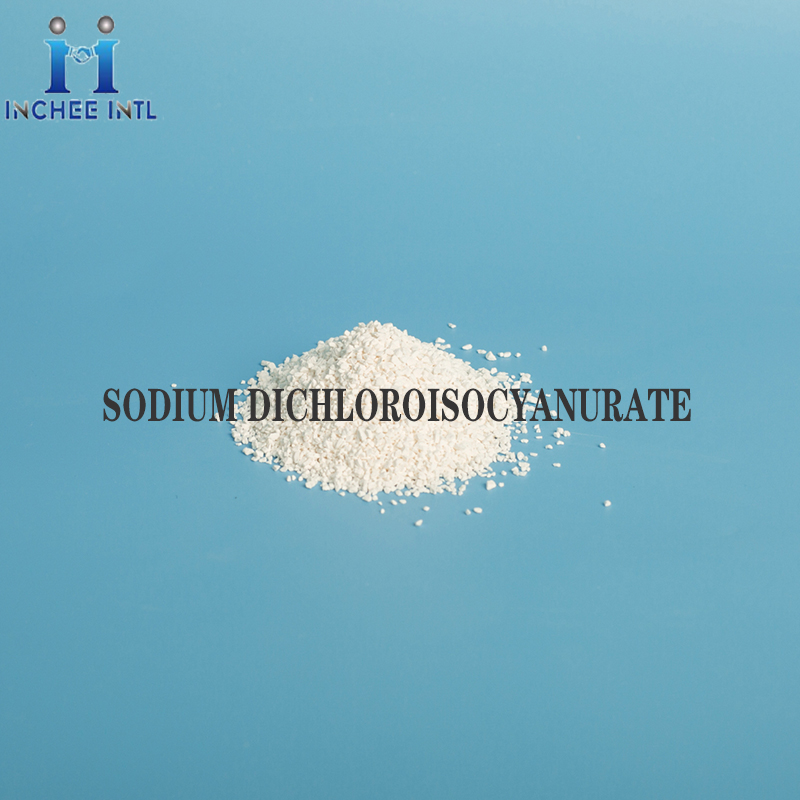
Manufacturer Good Price SODIUM DICHLOROISOCYANURATE CAS:2893-78-9

Synonyms
1,3,5-Triazine-2,4,6-(1H,3H,5H)trione,1,3-dichloro,sodiumsalt;1,3,5-Triazine-2,4,6(1H,3H,5H)-trione,1,3-dichloro-,sodiumsalt;1-sodium-3,5-dichloro-1,3,5-triazine-2,4,6-trione;3,5-triChemicalbookazine-2,4,6(1h,3h,5h)-trione,1,3-dichloro-sodiumsalt;4,6(1h,3h,5h)-trione,1,3-dichloro-s-triazine-sodiumsalt;4,6(1h,3h,5h)-trione,dichloro-s-triazine-sodiumsalt;acl60;BasolanDC(BASF).
Applications of SODIUM DICHLOROISOCYANURATE
Sodium dichloroisocyanurate can be used in drinking water disinfection, tableware disinfection; Can also be used for fruit, egg appearance disinfection, prolong storage period; It is widely used in large area disinfection of flood relief, prevention and disinfection of epidemic infectious disease areas; It can be used in the form of fumigation, water and powder to disinfect silkworm chambers, silkworm utensils and silkworm bodies in silkworm breeding fields and silkworm farmers. It can effectively prevent and cure fish diseases caused by bacteria, fungi and algae, and has obvious effect on fish viral diseases. By soaking wool or wool blended fibers and fabrics with 23% superior chlorine water purification solution and adding other additives, wool and its products can be pall free and feel free to reach the super washable standard issued by the International Wool Bureau.
1. Used as industrial water fungicide, drinking water disinfectant, swimming pool disinfectant, fabric finishing agent, etc
2. Used as a disinfectant, can be used for swimming pool, drinking water disinfection, preventive disinfection and environmental disinfection of various places. Can be used for sericulture, livestock, poultry, fish feeding disinfection Chemicalbook. Can also be used for wool anti-shrinkage finishing, textile industry bleaching, industrial circulating water algae removal, rubber chlorination agent, this product is efficient, stable performance, no adverse effects on human body.
3.GB 2760 -- 96 is specified as processing auxiliaries for food industry. It can be used for disinfecting dairy products and water. Can quickly kill all kinds of bacteria, fungi, spores and hepatitis A, hepatitis B virus. Can be widely used in swimming pool, family bathroom, household appliances, fruits and vegetables and indoor disinfection
4. Used for wool anti-felt shrinkage finishing, with the advantages of safe and convenient use, stable storage. It is also used as an efficient and fast cleaning disinfectant, bleaching agent, decolorization agent and fresh-keeping agent. BasolanDC is potassium dichloroisocyanurate, which can be used in Chemicalbook in acidic or weakly alkaline range (pH4-8) for anti-taping wool. It has good anti-taping effect in acidic range; It gives the wool a good feel in the alkaline range and adds luster. But it can also turn the fabric yellow.



Specification of VAE
|
Compound |
Specification |
|
Appearance |
White, free flowing granular product, free of lumps and foreign matter. |
|
Available chlorine Wt. % |
60%MIN |
|
PH value (1% water solution) |
5.0-7.0 |
|
Moisture (%) |
5%MAX |
|
Tablet |
8-30 |
Packing of VAE


25KG/BAG
Storage should be at cool, dry and ventilate.
FAQ
Q1: What is sodium dichloroisocyanurate? What are its core characteristics?
Sodium dichloroisocyanurate (DCCNa), commonly known as excellent chlorine, is a high-efficiency, broad-spectrum and low-toxicity organic chlorine disinfectant. It appears as white crystalline powder or granules with a slight chlorine odor. Its national standard available chlorine content is stably maintained at 55%–65%. It features fast dissolution, rapid efficacy, broad-spectrum sterilization, high stability, wide applicability and high cost performance. It rapidly hydrolyzes and releases hypochlorous acid when dissolved in water, which can quickly kill bacteria, viruses, fungi, spores and algae. With multiple functions of disinfection, algae removal, deodorization and bacteriostasis, it serves as a mainstream disinfectant for daily rapid sterilization scenarios.
Q2: How to choose between sodium dichloroisocyanurate and sodium trichloroisocyanurate (TCCA)? What are their core differences?
Both are organic chlorine disinfectants with complementary application scenarios and cannot be mixed or substituted. Sodium dichloroisocyanurate has a lower available chlorine content (55%–65%), featuring extremely fast dissolution, quick effect, no residual sediment and clean water body. It is suitable for emergency rapid disinfection, daily frequent sterilization, environmental spraying and equipment soaking. Sodium trichloroisocyanurate has high available chlorine (85%–95%) with slow-release and long-lasting efficacy, ideal for long-term water maintenance, algae and moss control, and stable water quality management. In short: choose DCCNa for fast sterilization, and choose TCCA for long-term water stabilization and algae removal.
Q3: What is the sterilization principle of sodium dichloroisocyanurate?
The product dissolves in water and rapidly hydrolyzes to produce hypochlorous acid. With strong oxidizing properties, it penetrates microbial cell walls, destroys bacterial proteins, enzyme systems and nucleic acid structures, and quickly inactivates various pathogenic bacteria, viruses, fungi and algae. Meanwhile, it oxidizes and decomposes trace organic matter in water and removes peculiar odors, achieving comprehensive effects of rapid sterilization, algae inhibition, water purification and deodorization. The solution is weakly acidic with high disinfection activity and fast reaction speed.
Q4: What are the common forms of sodium dichloroisocyanurate and their applicable scenarios?
There are two mainstream forms on the market: powder and granule. No slow-release tablets are available, focusing on rapid efficacy:
1. Powder type: Fastest dissolution, strong permeability and no residue, suitable for environmental spray disinfection, equipment soaking, emergency aquaculture sterilization, rapid sewage treatment and large-area air disinfection;
2. Granule type: Low dust, convenient feeding and uniform dispersion, suitable for whole-pond spraying in aquaculture, daily dosing of industrial circulating water and dry spreading for ground bacteriostasis, ensuring more convenient operation.
Q5: What is the difference between high-quality sodium dichloroisocyanurate and low-grade products?
High-quality national standard sodium dichloroisocyanurate has an available chlorine content of ≥60%, featuring high purity, few impurities, complete dissolution and no turbid sediment with stable sterilization speed, which will not cause water whitening or biological stress. Low-grade products have falsely labeled available chlorine, excessive impurities, turbid dissolution and weak sterilization performance. They fail to meet disinfection standards and easily cause aquaculture stress, slight equipment corrosion and residual peculiar odor on site, resulting in lower long-term cost performance. National standard high-content products are recommended for commercial disinfection.
Q6: What are the main industrial application scenarios of sodium dichloroisocyanurate?
1. Public environmental disinfection: Spray disinfection for floors, spaces and equipment in factories, parks, supermarkets, schools and public areas to quickly inhibit bacteria and prevent epidemics;
2. Aquaculture: Daily disinfection and disease prevention for fish, shrimp and crab breeding, improving water quality and bottom environment with rapid efficacy, low irritation and no residual sediment;
3. Industrial water treatment: Rapid sterilization and algae inhibition for circulating water, cooling water and reclaimed water to prevent bacterial growth and water odor deterioration;
4. Equipment and article disinfection: Soaking and wiping disinfection for aquaculture tools and public facilities with broad-spectrum and safe performance;
5. Fruit, vegetable and warehousing disinfection: Sterilization of storage sites and transportation tools to inhibit mold growth and delay food spoilage;
6. Auxiliary swimming pool disinfection: Daily chlorine supplement and emergency water sterilization to quickly restore qualified water quality standards.
Q7: Can sodium dichloroisocyanurate be used for drinking water disinfection?
Only qualified drinking-water-grade products can be used for secondary disinfection and pipe network bacteriostasis of domestic drinking water. Industrial-grade products are strictly prohibited for direct use in drinking water, food processing and food contact scenarios. Compared with TCCA, DCCNa dissolves faster with stable residual chlorine decline, making it suitable for daily maintenance and disinfection of drinking water systems with strict control of dosage and residual chlorine indicators.
Q8: What is the correct usage method of sodium dichloroisocyanurate?
1. Water body disinfection: Granules can be evenly sprinkled directly; powder is recommended to be fully dissolved, diluted and filtered with clean water before sprinkling to avoid excessive local concentration and biological stress;
2. Environmental spray disinfection: Dilute with water and spray evenly on floors, walls and air, then ventilate for more than 30 minutes after action;
3. Equipment soaking disinfection: Fully soak the equipment in diluted solution, then take it out, rinse with clean water and dry after the specified action time;
4. Daily maintenance: Adhere to the principle of small-dose and frequent dosing, suitable for regular and frequent disinfection; one-time high-dose impact treatment is not recommended.