



-
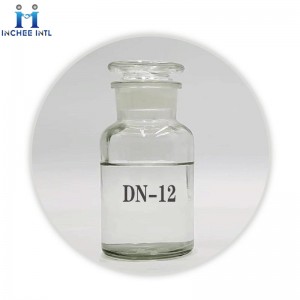
Manufacturer Good Price 2,2,4-Trimethyl-1,3-pentanediolmono(2-methylpropanoate) (DN12) CAS:25265-77-4
2,2,4-Trimethyl-1,3-pentanediolmono(2-methylpropanoate) is a volatile organic compound (VOC) being useful in paints and printing inks. As coalescent for latex paints, DN-12 finds applications in various fields including coatings, nail care, Printing inks, Solvents for cosmetics and personal care, plasticizers.DN-12 is also utilized as a coalescing agent to reduce the minimal film forming temperature (MFFT) during latex film preparation. Study using coupled capillary gas chromatography-mass spectrometry (HRGC-MS) has confirmed its detection in polypropylene packed food samples1. DN-12 is also employed in pharma industry. DN-12 may be further used in the prepare carbon nanotube (CNT) paste employed in field emission displays (FED).
2,2,4-Trimethyl-1,3-pentanediol monoisobutyrate (TMPD-MIB, texanol), a volatile organic compound (VOC), is an important component found in paints and printing inks. It is utilized as a coalescing agent to reduce the minimal film forming temperature (MFFT) during latex film preparation. Its detection in polypropylene packed food samples has been reported by coupled capillary gas chromatography-mass spectrometry (HRGC-MS). The performance of various dispersant affecting the dispersion of multi-walled carbon nanotube (MWCNT) in texanol has been studied.
CAS: 25265-77-4
-
Manufacturer Good Price 4-4′HYDROXYPHENYL SULPHONATE CONDENSATE SODIUM SALT CAS:102980-04-1
4-4′HYDROXYPHENYL SULPHONATE CONDENSATE SODIUM SALT:The anionospense is a category of surfactants, which is characterized by generating water -hate anion in the water.
In the production of surfactants, anion surfactants are the first type of product with the largest output and the most varieties. It is not only the main active components of daily chemical detergents and cosmetics, but also widely used in many other industrial fields. Whether in the field of industrial or civilian fields, anion surfactants can play an important role.
CAS: 102980-04-1
-
Manufacturer Good Price Titanium Dioxide CAS:1317-80-2
Titanium dioxide (or TIO2) is the most widely used white pigment in the industry, which is used in construction, industrial and automobile coatings; furniture, electrical appliances, plastic bands and plastic boxes are used; As well as special products such as ink, rubber, leather and elastic body.
Edible titanium dioxide, referred to as white pigment, non -toxic and tasteless. Flour, beverages, meatballs, fish balls, aquatic products, candy, capsule, jelly, ginger, tablets, lipstick, toothpaste, children’s toys, pet food and other white foods.
Titanium Dioxide CAS:1317-80-2
Product Name: Titanium Dioxide
Specification series: Titanium Dioxide R996; Titanium Dioxide R218; Titanium Dioxide TR92;Titanium Dioxide R908CAS: 1317-80-2
-
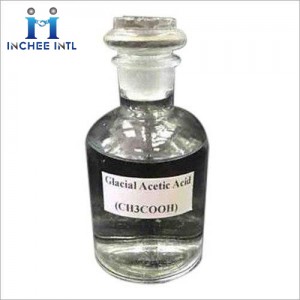
Manufacturer Good Price Glacial Acetic Acid CAS:64-19-7
Acetic acid is a colourless liquid or crystal with a sour, vinegar-like odour and is one of the simplest carboxylic acids and is an extensively used chemical reagent. Acetic acid has wide application as a laboratory reagent, in the production of cellulose acetate mainly for photographic film and polyvinyl acetate for wood glue, synthetic fibres, and fabric materials. Acetic acid has also been of large use as a descaling agent and acidity regulator in food industries.
CAS: 64-19-7
-

Manufacturer Good Price P-TOLUENESULFONYLISOCYANATE (PTSI) CAS 4083-64-1
P-TOLUENESULFONYLISOCYANATE (PTSI) is a single functional isocyanate. P-TOLUENESULFONYLISOCYANATE (PTSI) has high activity and can react with conventional diisocyanates, such as TDI and HDI, with water in polyols and solvents. The resulting carbamate does not increase the viscosity of the system. The disadvantage is that the toxicity of oxazolidine and other dehydrants is large; P-TOLUENESULFONYLISOCYANATE (PTSI) reacts with water to produce carbon dioxide and toluenesulfamide, so P-TOLUENESULFONYLISOCYANATE (PTSI) cannot be used directly in paint formulations and is generally used for pre-dehydration. To remove 1g of water in the solvent, about 12g of PTSI is theoretically required, but the actual amount should be higher than this.
CAS: 4083-64-1
-
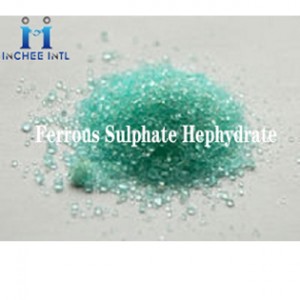
Ferrous sulfate heptahydrate CAS:13463-43-9
Ferrous Sulphate Hephydrate: Green vitriol, FeSO4.7H20, has been known since the thirteenth century ; it crystallizes from solutions of iron or iron bases in dilute sulphuric acid. The heptahydrate forms green monoclinic crystals of density 1·88, very soluble in water (296 g litre-1 FeS04 at 25°C). By precipitating the aqueous solution with ethanol, heating the heptahydrate to 140° in vacuo or by crystallizing it from 50 % sulphuric acid, the white monohydrate is obtained. This can be further dehydrated to the white, amorphous FeSO4 by heating to 300° in a current of hydrogen. At red heat the sulphate decomposes : 2FeS04 -> Fe203+S02+S03 A tetrahydrate, FeS04.4H20, crystallizes from aqueous solutions above 56°.
CAS: 7720-78-7
-
Manufacturer Good Price 1,2-propylene glycol CAS:57-55-6
Propylene glycol is used as antifreeze in breweries and diaries, in the manufacture of resins, as a solvent, and as an emulsifier in food. Propylene glycol was present as an occupational sensitizer in the color-film developer Flexicolor.
CAS: 57-55-6
-

Manufacturer Good Price Ammonium Chloride CAS:12125-02-9
Ammonium Chloride : (industrial grade) Ammonium chloride is colorless crystal or white crystalline powder; Odorless, salty and cool; It has the ability to attract moisture. This product is easily soluble in water, slightly soluble in ethanol.
Soluble in water, slightly soluble in ethanol, soluble in liquid ammonia, insoluble in acetone and diethyl ether. Hydrochloric acid and sodium chloride can reduce its solubility in water.
Ammonium Chloride CAS 12125-02-9
Product Name: Ammonium ChlorideCAS: 12125-02-9
-
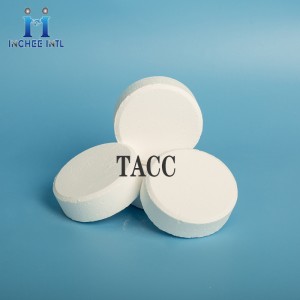
Manufacturer Good Price TACC CAS:87-90-1
TACC:A new type of sterilization disinfection agent that can generate trichlorisocyanocyanuric acid, while the latter will continue to dissolve in the water to leave activated chlorine and other ingredients. Quickly sterilize Chemicalbook disinfection agent. The product exists in the form of sodium salt, which has the characteristics of slow -release effects, and is used for washing bleaching agents for animal husbandry breeding and cotton and hemp fibrous fabrics. The content of effective chlorine in commodity -grade three -chlorocyanuric acid is greater than 85%.
TACC CAS:87-90-1
Product Name: TACCCAS: 87-90-1
-

Manufacturer Good Price Hydrogen Peroxide 50% CAS:7722-84-1
Hydrogen peroxide is a strong oxidant. The solution is commonly known as hydrogen peroxide. The pure product is a transparent liquid, which is odorless and bitter. The hydrogen peroxide contains the combined oxygen atom, so Hydrogen peroxide is strong oxidation and has a bleaching effect, which can disappear various pigments and not yellowish. But Hydrogen peroxide also has reduction. When the strong oxidant exists, Hydrogen peroxide is oxidized and oxygen. Although Hydrogen peroxide does not burn in itself, contact with flammable materials causes severe burning.
Synonyms:CAS: 7722-84-1
